
Legal Advice on Fine Art Insurance Claims and Coverage Disputes
Valuable artworks and collections require specialised insurance protection. If a painting, sculpture or other work of art is damaged, destroyed, stolen or lost, substantial financial interests may be at stake.
Disputes with art insurers frequently concern not only whether an insured event has occurred, but also the amount of compensation payable. Questions may arise regarding the insured value of an artwork, restoration costs, permanent loss in market value, exclusions from coverage, compliance with policy obligations and the consequences of underinsurance.
We advise and represent private collectors, museums, foundations, galleries, art dealers and other owners of artworks in connection with fine art insurance and claims against insurers under German law.
Fine Art Insurance in Germany
Specialised art insurance differs in important respects from conventional property insurance.
Depending on the policy, insurance may cover individual artworks, entire collections or changing inventories of artworks. Coverage may extend to works at the insured premises as well as artworks temporarily located elsewhere, exhibited, loaned or transported.
The scope of coverage depends primarily on the individual insurance contract and the applicable insurance terms.
When a loss occurs, it is therefore essential to examine not only the physical damage to the artwork but also the precise wording of the policy.
All-Risk Insurance for Art
Fine art insurance is frequently structured as all-risk or all-risks coverage.
Rather than covering only individually specified risks, such policies may provide broad protection against physical loss or damage unless the particular cause is excluded by the insurance contract.
Depending on the policy, this may include accidental damage, fire, water damage, theft, vandalism, damage during handling or other unforeseen events.
However, “all-risk” does not mean that every conceivable loss is necessarily covered.
Exclusions, deductibles, territorial limits, security requirements and other policy provisions must therefore be examined carefully when determining whether the insurer is liable.
What Is the Insured Value of an Artwork?
Determining the insured value of an artwork can be particularly difficult.
Unlike ordinary consumer goods, unique artworks may have no readily ascertainable replacement price. Market values may also change substantially over time.
The insurance policy may therefore use different methods of determining value.
Under German insurance law, the parties can agree upon a specified insured value (Taxe). Under § 76 of the German Insurance Contract Act (Versicherungsvertragsgesetz – VVG), such an agreed value generally determines the value of the insured interest at the time of the insured event, subject to the statutory requirements. Gesetze im Internet
For valuable artworks, the distinction between an agreed value, the insurance sum and the actual market value can have considerable financial consequences.
Agreed Value and Art Insurance
An agreed value can provide greater certainty as to the valuation of an artwork following a loss.
This is particularly important for unique or high-value works for which establishing the precise market value after destruction or theft may otherwise be difficult.
However, the existence and legal effect of an agreed value must be established from the policy and insurance terms.
German law also provides that an agreed value does not necessarily remain binding if it significantly exceeds the actual insurance value at the time of the insured event. Gesetze im Internet
For major claims, the precise contractual valuation mechanism should therefore be examined before accepting an insurer’s calculation of compensation.
Underinsurance of Art Collections
The market value of an art collection may increase considerably over time.
If the insurance sum is significantly lower than the insurance value at the time of the loss, the issue of underinsurance may arise.
Under § 75 VVG, the insurer may in principle be required to compensate only proportionately where the insurance sum is significantly below the insurance value. Gesetze im Internet
However, art insurance policies may contain different or more favourable contractual provisions, including waivers of the underinsurance defence.
Whether an insurer may reduce compensation because of underinsurance therefore requires examination of both the statutory provisions and the individual policy.
Artwork Damaged – What Does the Insurance Have to Pay?
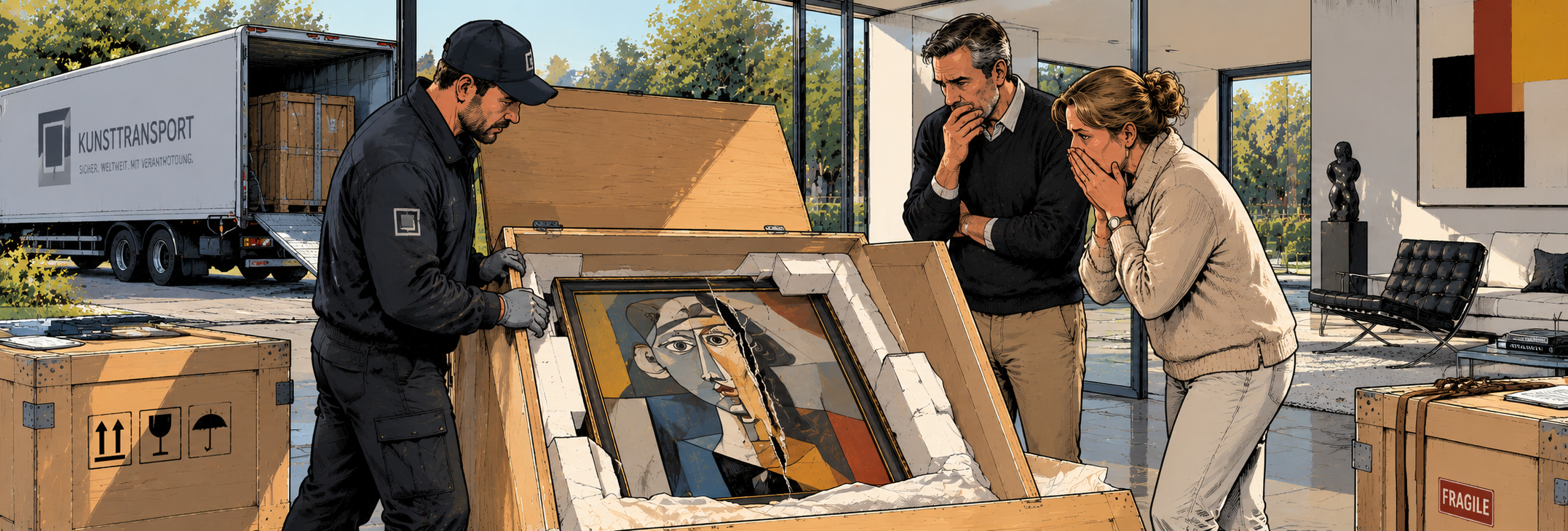
When an artwork is damaged but can be restored, determining the insured loss can be more complex than simply calculating the restoration invoice.
Depending on the policy and circumstances, relevant elements may include:
- conservation and restoration costs,
- costs of examination and damage assessment,
- necessary transportation and handling costs,
- costs of preventing further damage, and
- a potential permanent loss in market value following restoration.
The physical restoration of an artwork and the economic consequences of the damage should therefore be considered separately.
Loss in Value After Restoration
A professionally restored artwork may still be worth less than it was before the damage.
This is particularly relevant for important or high-value artworks.
Collectors may attach considerable importance to an artwork’s untouched original condition. A significant restoration can therefore affect its desirability and market value even where the damage is no longer readily visible.
The amount of any permanent depreciation depends on the individual work, the nature and location of the damage, the extent of the intervention and the relevant art market.
Whether such depreciation is covered by the insurance policy is a separate legal question.
In significant cases, it may therefore be necessary to obtain both a conservator’s assessment of the physical damage and an art-market valuation of the resulting economic loss.
Total Loss, Theft and Destruction of Art
If an artwork is stolen, destroyed or damaged beyond meaningful restoration, the valuation of the loss becomes particularly important.
The purchase price, current market value, replacement value, insurance sum and agreed value are not necessarily identical.
Which amount is recoverable depends on the insurance contract and the applicable law.
For unique works of art, valuation disputes can become particularly complex because there may be no equivalent object available on the market.
Who Is Insured if the Policyholder Does Not Own the Artwork?
Artworks are frequently located on premises or in collections operated by persons who are not their legal owners.
For example, artworks may belong to a company, partnership, family member, foundation or collector while another person has arranged the insurance.
This does not necessarily mean that the artwork is uninsured.
The decisive questions include which interests and objects are covered by the policy, whether third-party property is included and for whose account the insurance was taken.
In German insurance law, insurance can cover the interest of a third party. Whether this is the case in a particular art insurance policy requires careful examination of the insurance contract and the circumstances in which it was concluded.
Art Insurance for Loans and Exhibitions
Museums, collectors and galleries frequently lend artworks for exhibitions in Germany and abroad.
The loan agreement will often determine which party is responsible for arranging insurance and what level of coverage must be maintained.
Specialised exhibition insurance may cover an artwork from the time it leaves its usual location until it returns. Such coverage is often referred to in the art market as “nail-to-nail” or “wall-to-wall” coverage.
The precise beginning and end of insurance coverage should nevertheless be established from the policy rather than assumed from the terminology alone.
Where an artwork is damaged during an exhibition, both the loan agreement and the insurance policy should therefore be reviewed.
Art Insurance During Transport
Transport represents one of the principal risks for valuable artworks.
Art insurance may cover an artwork while it is packed, collected, transported, temporarily stored, unpacked and installed.
However, insurance coverage and carrier liability are legally separate.
If an artwork is damaged during transport, there may be both a claim under the art insurance policy and a claim against the fine art shipper, freight forwarder or carrier.
The insurer may also acquire claims against responsible third parties after compensating the insured.
For questions concerning the liability of carriers and fine art logistics companies, see our separate page on Art Transport Law in Germany.
Duties Following Damage to an Artwork
Once damage is discovered, evidence should be preserved immediately.
Depending on the circumstances, this may include:
- photographs and video recordings,
- condition reports,
- previous photographs of the artwork,
- transport and packing documents,
- damaged packaging,
- witness information,
- correspondence concerning the incident, and
- an initial conservator’s assessment.
The insurance contract should also be examined promptly for notification and cooperation requirements.
German insurance law contains statutory provisions concerning notification of an insured event, the insured’s duty to provide information and contractual obligations. The legal consequences of a breach depend on the particular circumstances and applicable policy terms. Gesetze im Internet
What Can I Do if the Art Insurer Refuses to Pay?
An insurer may reject or reduce a claim for various reasons.
The insurer may argue that:
- the event is not covered,
- a policy exclusion applies,
- the damage existed before the insured event,
- the artwork was inadequately protected,
- contractual obligations were breached,
- the claimed value is excessive,
- the collection was underinsured, or
- the claimed loss in value has not been established.
A denial of coverage should not automatically be accepted.
The insurance policy, applicable insurance terms, circumstances of the loss and available evidence should be examined to determine whether the insurer’s position is legally justified.
We advise and represent policyholders and other insured parties in negotiations and disputes with art insurers.
Expert Evidence in Art Insurance Disputes
Expert evidence can be particularly important in art insurance cases.
Different specialists may be required to answer different questions.
A conservator may assess the physical damage, determine the appropriate restoration method and estimate restoration costs.
An art-market expert may be required to determine the market value before and after the damage and assess any permanent depreciation.
The insurance policy may also provide for a particular expert determination procedure. German insurance law expressly recognises contractual expert procedures for determining the amount of loss under § 84 VVG. Gesetze im Internet
The selection of appropriate experts and the formulation of the questions they are asked can therefore have substantial legal and economic significance.
Dr. Louis Rönsberg – German Art Lawyer
Dr. Louis Rönsberg is a German-qualified lawyer and partner at SLB LAW in Munich.
He advises and represents private collectors, museums, foundations, galleries, art dealers and other participants in the art market in German art law matters, including disputes concerning damaged artworks and art insurance claims.
His work combines experience in art law, insurance-related disputes and litigation with an understanding of the particular issues involved in assessing damage to valuable artworks.
In significant art insurance cases, the legal analysis frequently requires coordination between lawyers, conservators, art-market experts and other specialists. Where appropriate, we coordinate the involvement of such experts and incorporate their findings into the legal strategy.
Legal Advice on Art Insurance Claims in Germany
We advise clients before and after insured events involving valuable artworks and collections.
Our work includes reviewing art insurance policies, assessing coverage, examining agreed values and underinsurance issues, determining restoration costs and permanent depreciation, and pursuing disputed claims against insurers.
Where an out-of-court resolution cannot be achieved, we also represent clients in litigation before German courts.
FAQs
What can I do if my art insurer refuses to pay a claim?
A denial of coverage does not necessarily mean that the insurer’s position is legally correct. The insurance policy, applicable terms and conditions, circumstances of the loss and reasons given for refusing coverage should be reviewed carefully.
Typical disputes concern policy exclusions, alleged breaches of contractual obligations, the cause of the damage, valuation of the artwork, underinsurance or whether the claimed loss in value is covered.
If substantial amounts are involved, it is advisable to have the insurer’s decision reviewed before accepting a settlement or final rejection.
Does art insurance cover loss in value after an artwork has been restored?
It depends on the insurance policy. An artwork can suffer a permanent reduction in market value even after a technically successful restoration. The fact that physical damage has been repaired therefore does not necessarily mean that the economic loss has disappeared.
Whether this residual depreciation is insured depends on the terms of the policy. Establishing its amount may require evidence from both a qualified conservator and an art-market expert.
What is an agreed value in German art insurance?
The insurer and policyholder can agree on a particular value for an insured artwork. German insurance law refers to such an agreed value as a Taxe.
Under § 76 VVG, the agreed value generally also applies as the value of the insured interest when the insured event occurs, unless it significantly exceeds the actual insurance value at that time. Gesetze im Internet
For valuable and unique artworks, an agreed value can therefore substantially reduce uncertainty concerning valuation after a loss.
What happens if my art collection is underinsured?
Under German law, significant underinsurance can result in a proportional reduction of the insurer’s payment. Section 75 VVG provides this as the general rule where the insurance sum is significantly below the insurance value at the time of the insured event. Gesetze im Internet
However, many insurance contracts contain specific provisions concerning underinsurance, and some policies expressly waive the underinsurance defence. The individual policy must therefore be reviewed before determining the amount payable.
Is an artwork insured if the policyholder is not its owner?
It can be. German insurance law permits insurance to cover another person’s interest, and art insurance policies may also expressly include third-party property.
This can be important where artworks belong to a company, partnership, family member, foundation, collector or consignor but are located at premises insured by another person.
The decisive issue is therefore not ownership alone. The policy must be examined to determine whose interest and which artworks are actually insured.
Is an artwork insured while being transported or loaned to an exhibition?
Many specialised art insurance policies provide transport and exhibition coverage, but this should not be assumed.
Coverage may apply during packing, transportation, temporary storage, installation, exhibition and return transport. Policies sometimes describe broad transit coverage as “nail-to-nail”.
The precise geographical, temporal and factual scope of the insurance nevertheless depends on the individual policy.
Who determines the amount of damage to an artwork?
Different experts may be required depending on the nature of the dispute.
A conservator can assess physical damage and restoration costs. An art-market expert may assess the artwork’s value before the incident and any permanent depreciation following restoration.
The insurance contract may also provide for an expert determination procedure. German insurance law specifically addresses contractual expert procedures concerning the amount of loss in § 84 VVG.

Has Your Art Insurer Refused or Reduced Your Claim?
We advise collectors, museums, foundations, galleries and art dealers on damaged, stolen or lost artworks, insurance coverage, agreed value, restoration costs, permanent loss in value and disputes with art insurers under German law.