


Legal Advice on Art Auctions in Germany
Art auctions are an important part of the German and international art market. Valuable paintings, sculptures, antiques and other works of art are regularly sold through auction houses in Germany.
Our German art lawyers advise and represent collectors, bidders, buyers, consignors and auction houses on all legal aspects of art auctions in Germany and cross-border auctions involving German law.
We advise both before an auction and when disputes arise after a sale. Our work includes auction terms and conditions, consignment agreements, catalogue descriptions, authenticity and attribution, provenance, ownership, reserve prices, liability and the rescission of auction purchases.
International clients can instruct us and communicate with us entirely in English.
Buying Art at Auction in Germany
Purchasing a work of art at auction differs in several respects from an ordinary private sale.
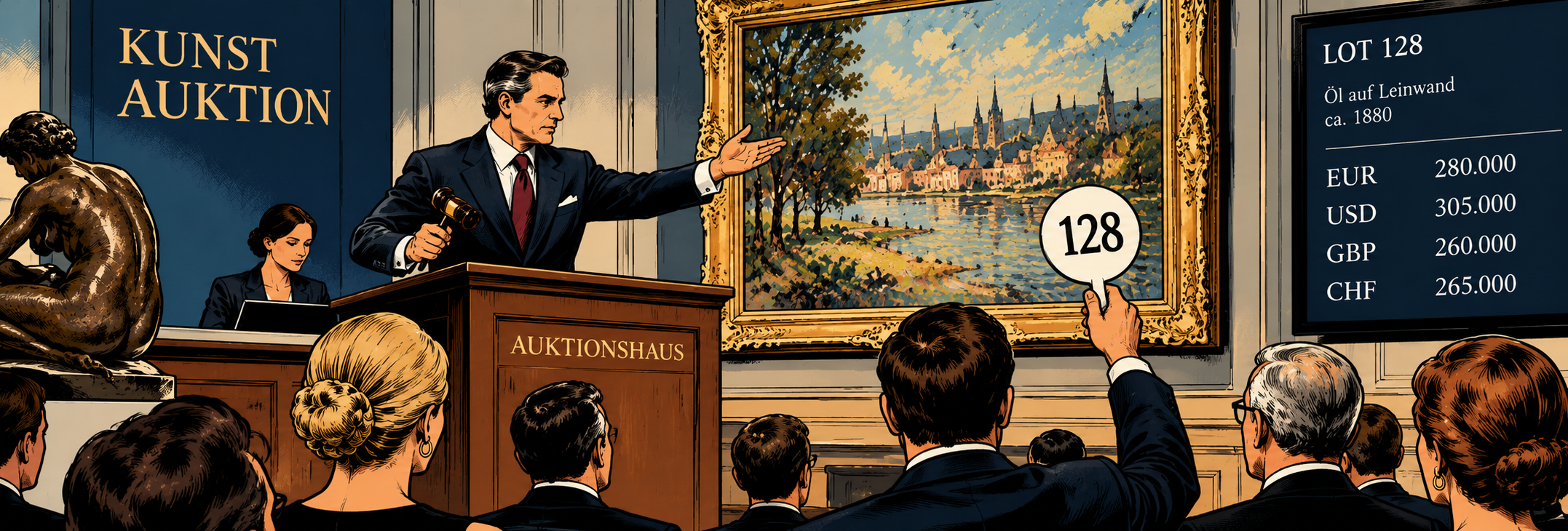
Under German law, a contract at an auction is generally concluded when the auctioneer accepts the bid by the fall of the hammer (Zuschlag). The legal relationship between the parties is also substantially influenced by the auction house’s terms and conditions.
Before bidding on a valuable work of art in Germany, buyers should therefore consider not only the catalogue description but also the applicable auction terms.
Important issues may include:
- the identity of the seller,
- the legal role of the auction house,
- authenticity and attribution,
- provenance and ownership,
- condition reports,
- estimates and reserve prices,
- buyer’s premium and additional charges,
- warranties and limitations of liability,
- payment and transfer of title,
- applicable law and jurisdiction, and
- import and export restrictions for cultural property.
For international buyers in particular, it may be advisable to clarify these issues before placing a significant bid.
Auction Terms and Conditions
The auction terms and conditions are of central importance in German art auctions.
They determine many of the rights and obligations of the auction house, consignor and successful bidder and frequently contain provisions concerning authenticity, attribution, catalogue descriptions, condition, liability, limitation periods, payment, collection of the artwork and applicable law.
We review auction terms for buyers and consignors before important transactions and advise auction houses on the drafting and updating of their terms and conditions.
Where a dispute has already arisen, we examine whether the relevant provisions were effectively incorporated into the contract and whether exclusions or limitations of liability are enforceable under German law.
Authenticity, Attribution and Art Forgeries
One of the most significant risks in the art market is that a work purchased at auction subsequently turns out to be a forgery or that doubts arise concerning its authenticity or attribution.
A painting catalogued as an original work by a particular artist may subsequently be rejected by an expert, an artist’s estate, a catalogue raisonné committee or another recognised authority. Scientific examination may also reveal materials or techniques inconsistent with the stated attribution.
In such cases, the legal consequences depend on the circumstances of the individual auction.
Relevant questions include:
- How was the artwork described in the auction catalogue?
- Was the attribution expressed as a fact or merely as an opinion?
- Were qualifications such as “attributed to”, “workshop of”, “circle of” or “school of” used?
- Were any guarantees given?
- What do the auction terms provide?
- Who was legally the seller?
- What information was available to the auction house and consignor?
- Can the buyer prove that the catalogue description was incorrect?
Depending on the circumstances, the buyer may have claims for rescission of the transaction, repayment of the purchase price, reduction of the price or damages.
We advise and represent buyers, consignors and auction houses in disputes concerning authenticity, attribution and alleged art forgeries.
Catalogue Descriptions and Incorrect Information
The auction catalogue is often of considerable legal importance.
Apart from authenticity and attribution, disputes may concern incorrect or incomplete information about:
- provenance,
- date of creation,
- artist or workshop,
- ownership history,
- exhibition history,
- literature and catalogues raisonnés,
- restoration and condition,
- dimensions and materials, or
- expert opinions and certificates.
Whether an incorrect catalogue description gives rise to legal claims under German law depends, among other things, on the precise wording of the description, the auction terms and the circumstances of the transaction.
In disputes concerning valuable works of art, we assess both the substantive legal position and the evidence required to establish or defend a claim.
Provenance and Ownership
Provenance is increasingly important in international art transactions.
A provenance issue may affect not only the market value of an artwork but also the question of whether the seller was legally entitled to transfer ownership.
Particular problems can arise where an artwork was previously:
- stolen,
- unlawfully removed from its owner,
- sold under questionable circumstances,
- lost during war or persecution,
- subject to competing ownership claims, or
- exported or imported in violation of cultural property regulations.
We advise buyers, consignors and auction houses on provenance and title issues before and after an auction.
Where appropriate, we work with specialised provenance researchers and other experts.
Stolen Art and Ownership Disputes
Special legal issues arise when a work offered or sold at auction is alleged to have been stolen.
German law contains specific rules governing the acquisition of ownership in movable property. Whether a purchaser can acquire title to an artwork despite problems in its ownership history requires careful analysis of the circumstances and the applicable law.
The situation becomes more complex where an artwork has crossed national borders, as different legal systems may apply different rules to the acquisition of title.
Stolen artworks offered at auction may also become the subject of criminal investigations, seizure or confiscation by German authorities.
We advise and represent collectors, owners, consignors and other parties in civil disputes concerning ownership as well as in related proceedings involving German authorities.
Nazi-Looted Art and Restitution at Auction
Questions concerning Nazi-looted art can arise before, during or after an auction.
An auction house may discover a gap or suspicious entry in the provenance of a consigned artwork. Heirs of a former owner may assert a restitution claim, or a buyer may discover after the auction that the work has a problematic history.
Such matters require a combination of legal analysis and historical provenance research.
Our German Art Law team advises heirs, collectors, consignors, museums, foundations and other current holders of artworks on Nazi-looted art and restitution claims in Germany.
Where appropriate, we coordinate the legal assessment with specialised provenance researchers.
Reserve Prices and Sales Below the Agreed Limit
Disputes may also arise between an auction house and a consignor where a work is sold below an agreed reserve price (Limit).
Relevant questions include whether a binding reserve was agreed, how the agreement was documented and whether the auctioneer was authorised to accept a bid below that amount.
A related issue is a conditional hammer price (Zuschlag unter Vorbehalt), where the effectiveness of the sale may depend on subsequent approval.
We advise consignors and auction houses on disputes concerning reserve prices, conditional sales and the contractual obligations arising from consignment agreements.
Consignment Agreements
For owners selling valuable artworks through a German auction house, the consignment agreement is an important contractual document.
It should clearly address issues such as:
- the description and attribution of the artwork,
- provenance information supplied by the consignor,
- reserve price,
- auction estimate,
- seller’s commission and other costs,
- authority of the auction house,
- liability for loss or damage,
- insurance,
- withdrawal of the artwork,
- unsold lots,
- post-auction sales,
- payment of the proceeds, and
- warranties and liability of the consignor.
We review and draft consignment agreements and advise consignors and auction houses on disputes arising from them.
Artwork Sold Far Below Market Value
A particularly difficult situation can arise where a consignor discovers after an auction that an artwork may have been worth substantially more than the price achieved.
A low auction result alone does not automatically entitle the consignor to reverse the transaction.
Depending on the circumstances, however, questions may arise concerning an incorrect attribution or estimate, mistake, duties owed by the auction house, the agreed reserve price or other circumstances surrounding the consignment and auction.
These cases require a detailed examination of the consignment agreement, catalogue description, expert information available before the auction and the circumstances of the sale.
Online Art Auctions
Art auctions increasingly take place online or combine a traditional saleroom auction with internet and telephone bidding.
Online participation may raise additional questions concerning:
- the time at which a binding bid is made,
- technical bidding errors,
- the identity of the bidder,
- consumer protection rules,
- withdrawal rights,
- applicable law and jurisdiction, and
- cross-border enforcement.
Whether statutory consumer withdrawal rights apply depends on the precise structure of the auction and the circumstances of the transaction.
International bidders should therefore not assume that an online art purchase can automatically be cancelled simply because the bid was placed over the internet.
International Art Auctions and German Law
The international nature of the art market frequently creates complex questions of applicable law and jurisdiction.
For example, the buyer may be based in the United States or the United Kingdom, the auction house in Germany, the consignor in another country and the artwork itself may have been transported across several jurisdictions.
In such cases, it may be necessary to determine:
- which country’s law applies,
- which courts have jurisdiction,
- where ownership passed,
- whether foreign judgments can be recognised and enforced,
- whether cultural property restrictions apply, and
- how an artwork or other evidence can be secured during a dispute.
We regularly advise international clients on art auction disputes involving Germany and German law and cooperate with lawyers in other jurisdictions where necessary.
Evidence in Art Auction Disputes
Art auction disputes frequently turn on evidence.
Where authenticity, attribution, provenance or condition is disputed, the legal case may depend on expert opinions, provenance documents, scientific analysis and the wording of catalogue descriptions and correspondence.
We therefore consider from the outset not only whether a client may have a claim under German law, but also who bears the burden of proof and how the relevant facts can be established before a German court.
Depending on the case, we work with art historians, provenance researchers, restorers, scientific laboratories and other specialised experts.
Dr. Louis Rönsberg – German Art Auction Lawyer
Dr. Louis Rönsberg is a German-qualified lawyer (Rechtsanwalt) and partner at SLB LAW in Munich. He has advised and represented collectors, buyers, sellers, art dealers and auction houses on German art law and art auction law for many years.
His practice includes disputes concerning authenticity and attribution, art forgeries, provenance and ownership, auction terms, consignment agreements and the rescission of art purchases.
As an experienced litigator, Dr. Rönsberg also represents clients in complex art disputes before German courts. Questions of evidence, expert testimony and the procedural enforcement or defence of claims are therefore considered from the beginning of a matter.
He advises clients from Germany and abroad and can conduct mandates entirely in English.

Legal Advice on Art Auctions in Germany
We advise international collectors, bidders, consignors, art dealers and auction houses before and after art auctions in Germany.
Whether you are considering bidding on an important artwork, consigning a collection to a German auction house or are already involved in a dispute concerning authenticity, provenance, ownership or an auction transaction, we can assess your position under German law.

Do You Need Legal Advice on an Art Auction in Germany?
We advise collectors, bidders, consignors and auction houses on art auction transactions and disputes – including authenticity, provenance, auction terms and liability under German law.