


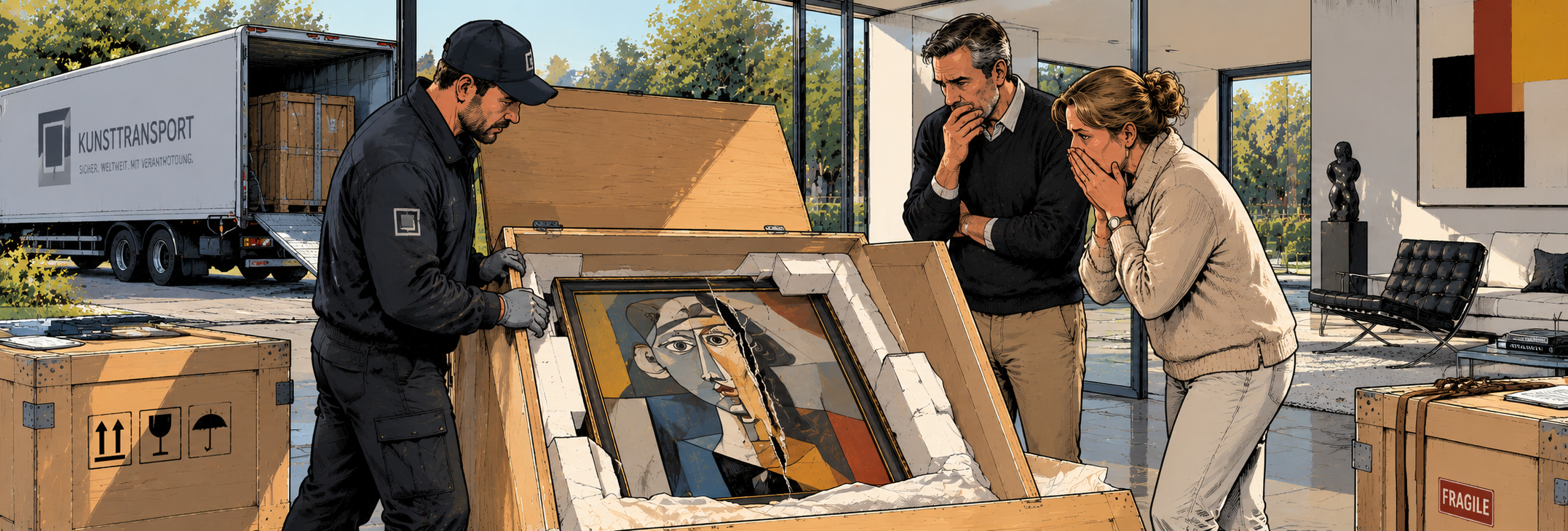
Legal Advice on Damaged and Lost Artworks and International Fine Art Shipping
Transporting valuable artworks involves particular risks. Paintings, sculptures, antiques and other cultural objects may be damaged by impact, vibration, inadequate packaging, humidity, temperature fluctuations or improper handling.
If an artwork arrives damaged or is lost during transportation, complex legal questions can arise: Who is liable for the damage? Was the artwork properly packed? Is the fine art shipper or carrier responsible? Do statutory or contractual limitations of liability apply? And how can the loss in value of a damaged and subsequently restored artwork be established?
We advise and represent private and institutional collectors, galleries, art dealers, auction houses, museums, foundations and other owners of artworks in connection with domestic and international art transportation and claims arising from damaged or lost works of art.
Artwork Damaged During Transport – Who Is Liable?
When an artwork is damaged during transportation, the first question is usually when, where and how the damage occurred.
This can be difficult to establish.
Damage may occur during packing, loading, transportation, transshipment, temporary storage, customs handling, unloading, unpacking or installation. In some cases, it may also be disputed whether the damage already existed before the artwork was handed over for transportation.
The entire chain of transportation therefore needs to be reconstructed.
Depending on the contractual arrangements and the circumstances of the loss, claims may exist against a fine art shipper, carrier, freight forwarder, warehouse operator, packing company or another participant in the transportation chain.
Liability of Fine Art Shippers and Carriers in Germany
Specialised fine art logistics companies frequently provide considerably more than transportation alone.
Their services may include:
- packing and crating,
- collection and delivery,
- road or air transportation,
- temporary storage,
- customs handling,
- installation and deinstallation, and
- coordination of other carriers and subcontractors.
The applicable liability regime depends on the services actually agreed and performed.
Under German law, it is therefore important to determine whether the company acted as a carrier, freight forwarder, warehouse operator or in another capacity.
This distinction may determine the basis and extent of liability.
Packing and Handling of Valuable Artworks
Appropriate packaging is one of the most important elements of a safe art transport.
The requirements depend on the type, material, age, condition and sensitivity of the particular artwork. Valuable or fragile objects may require custom-built crates, specialised cushioning or climate-controlled packaging.
If an artwork is damaged, inadequate packaging frequently becomes a central issue.
It may be disputed whether the shipper was responsible for packing the artwork, whether the packaging complied with the agreed or professionally required standard, or whether the characteristics of the artwork required additional protective measures.
The packaging itself can therefore become important evidence and should generally be preserved following a transport damage.
International Art Transport
International fine art transportation may involve several different legal regimes.
The applicable rules can depend on the route, mode of transport and contractual arrangements.
Different liability regimes may apply to:
- international road transport,
- air freight,
- sea transport,
- multimodal transportation,
- temporary storage, and
- domestic pre-carriage or onward transportation.
The applicable regime can have significant consequences for liability, compensation limits, notification requirements and limitation periods.
For international art transport disputes, it is therefore important to establish precisely where the damage occurred and which legal regime governs the relevant part of the transportation.
Art Transport by Air Freight
High-value artworks are frequently transported internationally by air.
International air carriage may be subject to specific international liability rules governing loss, damage and delay.
The legal assessment can become particularly complex where the overall transportation includes road transportation to the airport, international air freight, intermediate storage and onward transportation from the destination airport.
If damage occurs, it may therefore be necessary to determine the particular stage of transportation during which the artwork was damaged before the applicable liability regime can be established.
Limitations of Liability for Damaged Artworks
One of the most important issues in art transportation is the potential limitation of the carrier’s liability.
Transport law frequently limits compensation by reference to the weight of the goods rather than their market value.
This can create a substantial discrepancy in the case of art.
A painting weighing only a few kilograms may be worth hundreds of thousands or several million euros, while the carrier’s statutory liability may be only a fraction of the artwork’s actual value.
Whether a limitation applies depends on the applicable legal regime, contractual arrangements and circumstances of the damage. In certain cases involving qualified misconduct, statutory limitations of liability may cease to apply.
For high-value artworks, liability and insurance should therefore ideally be considered before transportation begins.
Burden of Proof in Art Transport Claims
Questions of evidence are frequently decisive in disputes concerning damaged artworks.
It may be necessary to establish that the artwork was handed over to the carrier in undamaged condition and was damaged before or upon delivery.
Important evidence may include:
- condition reports,
- photographs and videos taken before and after transportation,
- transport documents,
- delivery and handover records,
- packing lists,
- crate and packaging documentation,
- temperature or humidity records,
- witness statements, and
- expert reports.
For valuable artworks, comprehensive condition documentation before transportation can significantly improve the evidentiary position if damage subsequently occurs.
What Should I Do If an Artwork Arrives Damaged?
If damage is discovered when a transport crate is opened, the condition of both the artwork and its packaging should be documented immediately.
Where possible, the following evidence should be preserved:
- photographs and video recordings of the artwork,
- photographs of the crate before and during opening,
- all packing materials,
- transport and delivery documents,
- existing pre-transport condition reports,
- previous photographs of the artwork, and
- details of persons present when the crate was opened.
The artwork should generally be examined promptly by an appropriately qualified conservator or expert.
It is also important to establish whether the damage must be notified to the carrier, shipper or another party within a particular period. Transport law may provide for short notification, exclusion or limitation periods.
Damage, Restoration Costs and Loss in Value
Damage to an artwork is not necessarily limited to the cost of restoration.
Even after technically successful conservation or restoration, an artwork may have suffered a permanent reduction in market value.
This can be particularly important for high-value works.
The assessment of such a loss in value may depend on factors including:
- the artist and significance of the work,
- the nature and extent of the damage,
- the affected part of the artwork,
- the visibility and permanence of the restoration,
- the artwork’s previous condition, and
- the likely reaction of the relevant art market.
A conservator can assess the physical damage and restoration requirements. Determining the resulting market depreciation may additionally require an art-market expert.
Total Loss or Loss of an Artwork
If an artwork is destroyed or permanently lost during transportation, the central question becomes the amount of compensation recoverable.
Different concepts of value may be relevant.
The purchase price, market value, replacement value and insured value are not necessarily identical. Which value is legally relevant depends on the basis of the claim and the applicable contractual or statutory rules.
The valuation of unique artworks can be particularly difficult because an identical replacement may not exist.
Artwork Damaged During an Exhibition or Loan
Art transportation frequently forms part of a museum exhibition, gallery exhibition or institutional loan.
In such cases, several contractual relationships may overlap.
The owner may have a loan agreement with a museum, while the museum has separately instructed a fine art shipper and arranged insurance.
If the artwork is damaged, it may therefore be necessary to examine:
- the loan agreement,
- the transport agreement,
- responsibility for packing and installation,
- insurance arrangements, and
- the respective obligations of the lender, borrower and logistics companies.
Depending on the circumstances, claims may potentially exist against more than one party.
Cultural Property Law and International Art Transport
International transportation of artworks can also involve German and European cultural property regulations.
An export licence may be required for certain cultural objects leaving Germany. Imports into Germany may raise questions concerning provenance and evidence of lawful export from the country of origin.
This applies not only to permanent sales.
Temporary transportation for exhibitions, art fairs, restoration or loans may also require consideration of cultural property regulations.
International art transportation should therefore be coordinated with the applicable German Cultural Property Law requirements.
Art Transport Insurance
Because carrier liability may be substantially lower than the value of the transported artwork, adequate insurance coverage is particularly important for high-value art transportation.
Depending on the circumstances, specialised art transport insurance may cover physical damage, destruction or loss during transportation and related activities.
Insurance and carrier liability are, however, legally distinct.
A claim against the carrier is governed by the applicable transport liability regime, whereas a claim against the insurer depends primarily on the insurance contract and policy terms.
We therefore recommend examining both potential routes of recovery following a significant transport loss.
For disputes concerning insurance coverage, claims handling, insured value or denial of coverage, see our separate page on Art Insurance Law in Germany.
Dr. Louis Rönsberg – German Art Lawyer
Dr. Louis Rönsberg is a German-qualified lawyer and partner at SLB LAW in Munich.
He has many years of experience in German art law as well as domestic and international transport and freight forwarding law.
This combination is particularly relevant in fine art transport disputes. Such cases frequently require both knowledge of the applicable transport liability regimes and an understanding of the particular characteristics of valuable artworks, including professional packing, conservation, restoration, valuation and permanent loss in market value.
Dr. Rönsberg advises and represents collectors, galleries, art dealers, auction houses, museums and other clients in claims against fine art shippers, carriers, freight forwarders and other parties involved in the transportation of artworks.
Where appropriate, we coordinate the involvement of conservators, art-market experts and other specialists.

Legal Advice on Art Transport Claims in Germany
We advise on the legal aspects of domestic and international fine art transportation and represent clients in disputes concerning damaged, destroyed or lost artworks.
Our work includes the assessment of contractual and statutory liability, limitations of liability, international transport regimes, evidence and documentation, restoration costs and permanent loss in value.
We represent clients in negotiations and, where necessary, in litigation before German courts.

Has an Artwork Been Damaged or Lost During Transport?
We advise collectors, museums, galleries, art dealers and auction houses on damaged or lost artworks, fine art shipping claims and carrier liability under German and international transport law.