


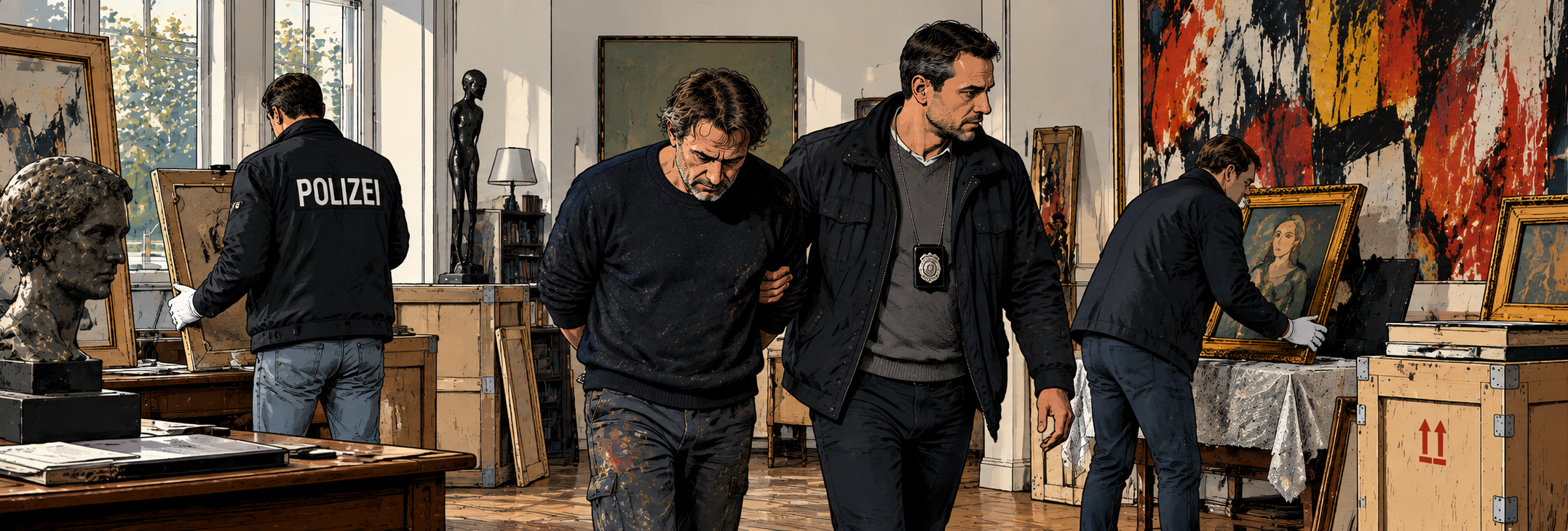
Legal Advice and Representation in Criminal Cases Involving Art and Cultural Property
Criminal investigations involving art and cultural property often combine criminal law with highly specialised questions of art law, provenance, ownership and cultural property regulation.
A collector may discover that an artwork purchased years ago is suspected of having been stolen. An art dealer may face allegations concerning the provenance or importation of an antiquity. Customs authorities may detain a cultural object at the German border. A search warrant may be executed at a gallery, private collection or business premises. An artwork may be seized during criminal proceedings.
For international collectors, galleries, art dealers and other market participants, proceedings in Germany can be particularly difficult to navigate because the underlying allegations may depend not only on German criminal law but also on the German Cultural Property Protection Act (Kulturgutschutzgesetz – KGSG), foreign export laws, provenance records and international transactions.
We advise and represent collectors, art dealers, galleries, auction houses and other participants in the art market in criminal and regulatory matters involving artworks and cultural property in Germany.
Criminal Law and the Art Market
There is no single German statute covering all forms of “art crime”.
Depending on the circumstances, criminal proceedings involving artworks may concern allegations relating to:
- stolen artworks,
- art forgery and fraud,
- handling or selling stolen property,
- unlawful import or export of cultural property,
- illegally excavated archaeological objects,
- false or incomplete provenance information,
- customs offences,
- violations of the German Cultural Property Protection Act,
- confiscation or seizure of artworks, or
- other offences arising from art transactions.
The legal assessment therefore frequently requires expertise extending beyond general criminal law.
The origin, ownership history, authenticity and cross-border movement of the artwork may be as important as the criminal-law allegations themselves.
Criminal Offences under the German Cultural Property Protection Act – KGSG
The German Cultural Property Protection Act contains specific criminal and administrative offences relating to cultural property.
Section 83 KGSG criminalises, among other conduct, certain unlawful exports of cultural property, the knowing import of cultural property removed in violation of specified foreign laws and the placing on the market of certain lost, unlawfully excavated or unlawfully imported cultural property. Attempted offences are also punishable.
Depending on the offence, penalties can include imprisonment of up to five years or a fine. In certain cases involving the commercial or organised placing on the market of prohibited cultural property, § 83 KGSG provides for imprisonment from one to ten years. Certain negligent export violations committed in the course of a commercial activity can also constitute criminal offences.
The distinction between intentional conduct, knowledge, negligence and a mere regulatory violation can therefore be decisive.
Illegal Import of Cultural Property into Germany
Importing art or cultural property into Germany can give rise to criminal-law issues where the object was unlawfully removed from another country.
This is particularly relevant for archaeological objects and antiquities originating from jurisdictions with strict cultural heritage and export legislation.
The fact that an object was purchased in good faith on the international art market does not necessarily resolve every issue concerning its importation or provenance.
German law prohibits certain imports of unlawfully removed cultural property, and § 83 KGSG contains criminal provisions concerning the knowing import of cultural property removed contrary to legislation covered by § 28 KGSG.
In such cases, the legal assessment may require examination of foreign export legislation, historic export documents, acquisition records and the provenance of the object.
Illegal Export of Art from Germany
Certain artworks and cultural objects require an export licence before they may legally leave Germany.
Export restrictions may arise under German law or directly applicable European Union legislation.
Exporting cultural property without a required licence can constitute a criminal offence. Section 83 KGSG provides for criminal liability for specified unlawful exports and also covers exports contrary to the applicable EU export regime.
For professional market participants, the risks can be particularly significant because certain negligent export violations committed in the course of a commercial activity may also be punishable.
For further information on licensing requirements, see German Cultural Property Law.
Customs Detention and Seizure of Artworks
German customs authorities play an important role in controlling the cross-border movement of cultural property.
An artwork or antiquity may attract attention because an export licence is missing, the provenance or country of origin is unclear, the necessary import documentation cannot be produced or authorities suspect that the object was unlawfully exported from another country.
Under § 33 KGSG, the competent authority must secure (sicherstellen) cultural property where specified statutory conditions are met, including certain suspected unlawful imports or exports and cases where required import documentation is not produced. Gesetze im Internet
It is important to distinguish such an administrative Sicherstellung under the KGSG from a seizure or confiscation in criminal proceedings.
Where criminal proceedings are initiated, customs investigation offices may also become involved. The KGSG expressly provides for investigative functions of the customs authorities in specified criminal and administrative-offence cases.
Search of a Home, Gallery or Business Premises
Art-related investigations can result in searches of private homes, galleries, warehouses or business premises.
For the person concerned, the immediate priority should be to understand:
- which offence is being investigated,
- against whom the proceedings are directed,
- which artworks or documents are sought,
- what the search warrant permits, and
- which objects or records have been seized.
Art investigations may involve not only artworks themselves but also invoices, provenance documentation, correspondence, photographs, export documents, databases and electronic communications.
The legal defence should therefore address both the criminal allegations and the art-law background of the transaction.
Seizure and Confiscation of Artworks
An artwork may itself become the subject of governmental measures.
This can be particularly significant where authorities suspect that an artwork was stolen, unlawfully excavated, illegally imported or exported, or involved in a criminal transaction.
Under § 85 KGSG, objects connected with offences or specified administrative violations under the KGSG can be subject to confiscation (Einziehung).
For a collector or art dealer, the economic consequences can be substantial even before the criminal proceedings have been concluded.
It is therefore important to distinguish carefully between temporary seizure or securing of the artwork during an investigation and its final confiscation.
Stolen Art and Criminal Proceedings
The discovery of a potentially stolen artwork can trigger both civil-law and criminal-law questions.
Authorities may investigate how the artwork entered the current owner’s possession, who previously owned it and whether anyone involved knew of its unlawful origin.
For a collector who acquired the work years earlier, provenance documents, invoices, correspondence with the seller and evidence of the circumstances of acquisition may become important.
The criminal investigation and the question of who legally owns the artwork must nevertheless be distinguished. A criminal investigation does not by itself determine all civil-law ownership issues.
Archaeological Objects and Antiquities
Antiquities and archaeological objects present particular risks.
Their legal status may depend on the law of the country in which they were excavated or discovered, historic export restrictions and the circumstances in which they entered the international art market.
German cultural property law expressly prohibits the placing on the market of cultural property that has been unlawfully excavated and imposes due-diligence obligations in connection with cultural property transactions. Sections 40 and 41 KGSG are particularly relevant in this respect.
Where authorities suspect illegal excavation or export from a country of origin, the investigation may therefore extend far back into the object’s provenance.
Art Forgery and Fraud
Art forgery cases can involve substantial financial losses and complex questions of evidence.
Criminal proceedings may arise where a forged artwork is knowingly presented and sold as an authentic work by a particular artist or where false information concerning attribution, provenance or authenticity is used to induce a buyer to purchase the work.
In such cases, criminal law and civil art law frequently overlap.
The investigation may require art-historical expertise, scientific examination, provenance research and analysis of certificates, catalogue raisonné entries and previous transactions.
At the same time, buyers may have civil claims relating to the purchase of the artwork.
For further information on the civil-law aspects, see Art Forgery & Authenticity Disputes in Germany.
Duties of Art Dealers and Other Professional Market Participants
Professional participants in the German art market are subject to particular duties when placing cultural property on the market.
The KGSG contains general and enhanced due-diligence requirements concerning, among other matters, whether cultural property has been lost, unlawfully imported or illegally excavated. Section 41 KGSG requires appropriate checks where circumstances would cause a reasonable person to suspect such a problem.
Violations of certain statutory duties can constitute administrative offences. Under § 84 KGSG, fines can reach up to €100,000 depending on the violation; some specified breaches carry a maximum fine of €30,000.
Where an investigation concerns a dealer, gallery or auction house, the distinction between a criminal offence and an administrative violation may therefore be central to the defence.
International Collectors and Art Dealers Facing Proceedings in Germany
A person does not need to live in Germany to become involved in German proceedings concerning an artwork.
An international collector may, for example, send an artwork to Germany for sale, purchase an object from a German dealer or auction house, import an antiquity into Germany or attempt to export a recently purchased artwork.
If German authorities initiate proceedings, international clients need counsel who can address both the procedural issues in Germany and the underlying art-law questions.
We advise international clients in English and can coordinate with foreign lawyers, provenance researchers, art historians and other experts where necessary.
Early Legal Advice in Art-Related Investigations
The early stages of criminal proceedings can be particularly important.
Before providing detailed statements to investigating authorities, the allegations and available records should be reviewed carefully.
In art-related cases, this may include:
- purchase agreements and invoices,
- provenance records,
- export and import documents,
- customs documentation,
- certificates and expert opinions,
- correspondence with dealers, sellers or auction houses, and
- records concerning previous owners and transactions.
The appropriate defence strategy depends on the specific allegations and available evidence.
Dr. Louis Rönsberg – German Art Lawyer
Dr. Louis Rönsberg advises German and international clients on complex art-law disputes and matters involving cultural property.

Art-related criminal proceedings often require a combination of legal disciplines: criminal procedure may determine the immediate response to an investigation, while questions of provenance, ownership, cultural property law, international transactions and the structure of the art market determine the substantive background.
Where necessary, we work with specialised criminal defence counsel and coordinate the art-law aspects of the defence as well as the involvement of provenance researchers, art historians and other experts.
Legal Advice on Art Crime and Criminal Proceedings in Germany
We advise collectors, galleries, art dealers, auction houses and other participants in the art market in connection with:
- criminal investigations involving artworks and cultural property,
- unlawful import or export allegations,
- proceedings under the German Cultural Property Protection Act,
- customs investigations,
- seizure or securing of artworks,
- stolen art,
- illegally excavated antiquities,
- art forgery and fraud cases,
- provenance-related investigations, and
- related civil and regulatory issues.
For international clients, our advice and communication can be provided entirely in English.
FAQs
What should I do if German customs detain an artwork or antiquity?
The legal basis for the detention should be reviewed promptly. Relevant issues may include missing export or import documents, provenance, the country of origin and whether authorities suspect an unlawful import or export.
Do not dispose of relevant documents. Purchase records, provenance documentation, export permits and correspondence may be important in establishing the legal status of the object.
What should I do if the police search my home, gallery or business in Germany?
The search warrant and the precise allegations should be examined as soon as possible. Relevant documents and records should be preserved.
Before making substantive statements about the allegations, it is generally advisable to understand the investigation and review the relevant files and evidence.
Can an artwork be seized during a criminal investigation in Germany?
Yes. Depending on the circumstances, artworks may be seized or otherwise secured during an investigation.
In addition, the KGSG contains specific provisions on the administrative securing of cultural property and on confiscation following certain criminal or administrative violations. The legal basis and available remedies depend on the particular measure.
Is illegally exporting an artwork from Germany a criminal offence?
It can be. Section 83 KGSG criminalises specified exports of cultural property in violation of German or EU export restrictions. Depending on the offence, penalties can include imprisonment or a fine. Certain negligent export violations committed in a commercial activity can also be punishable.
Whether an export licence is required should therefore be checked before the artwork leaves Germany.
Can I get into trouble in Germany for buying an antiquity that was illegally exported from another country?
Potentially. The legal consequences depend on the object’s origin, the applicable foreign law, the circumstances of its export and import, and what the buyer or seller knew.
For antiquities with unclear provenance, these issues should ideally be investigated before acquisition or import into Germany.
What penalties apply for violations of the German Cultural Property Protection Act?
Section 83 KGSG provides for imprisonment of up to five years or a fine for several offences. Certain commercial or organised offences can carry imprisonment from one to ten years. Section 84 KGSG separately provides for administrative fines of up to €100,000 for specified violations. The applicable penalty depends on the precise allegation and whether the conduct was intentional or negligent.
Can criminal proceedings and an ownership dispute over the artwork take place at the same time?
Yes. Criminal allegations and civil-law ownership are separate legal questions.
For example, authorities may investigate whether an artwork was stolen or illegally imported while, at the same time, different parties dispute who owns it. Both aspects may therefore need to be addressed in parallel.

Are You Facing an Art-Related Investigation in Germany?
We advise international collectors, galleries, art dealers, auction houses and other art-market participants in matters involving customs detention, seizure of artworks, unlawful import or export, stolen art, antiquities, art forgery and proceedings under the German Cultural Property Protection Act (KGSG).
If German customs, police, prosecutors or cultural property authorities have contacted you concerning an artwork or cultural object, we can assess the German art-law implications and coordinate the appropriate legal response.