


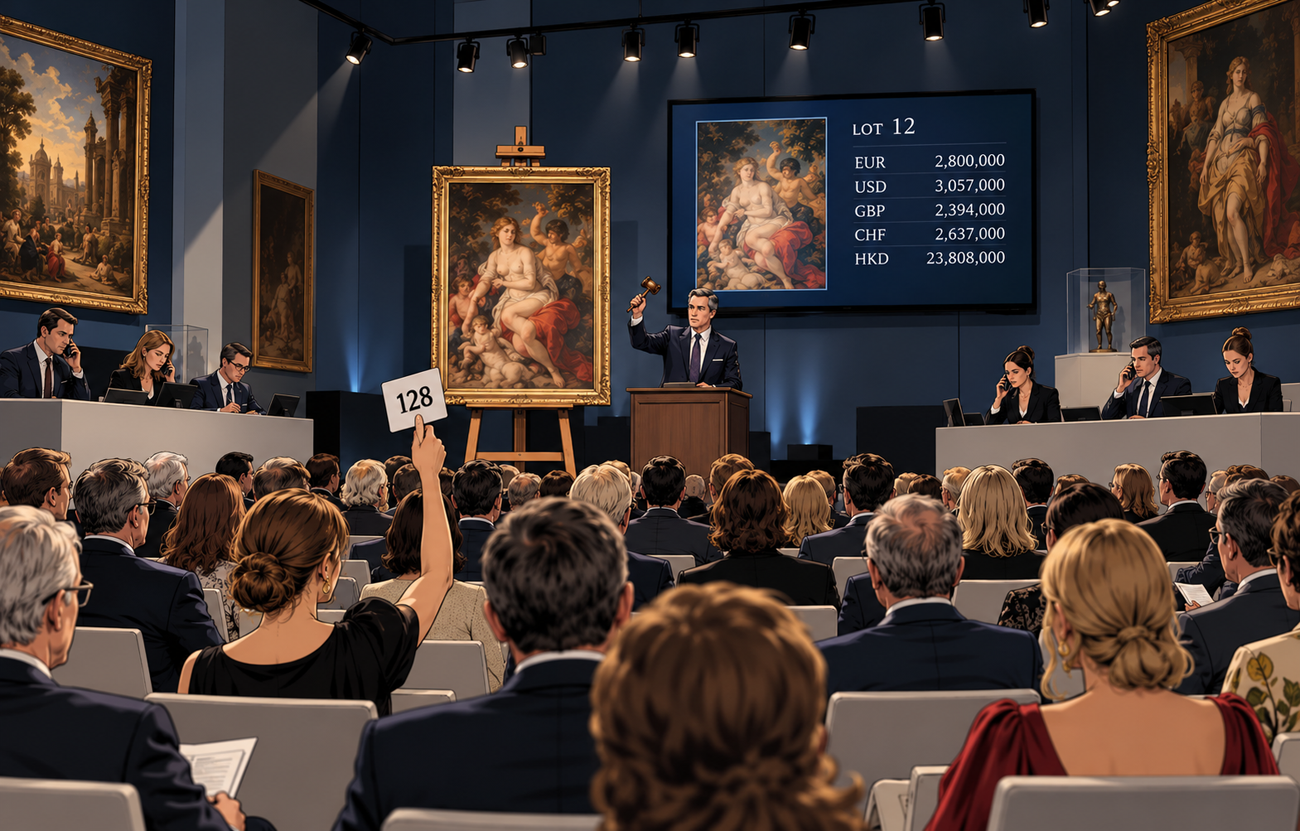
Have you purchased a painting, sculpture or antique at a German auction house, only to discover later that it may be a forgery, replica or incorrectly attributed work of art? Under German art auction law, buyers may be entitled to cancel the purchase, recover the purchase price, claim damages or obtain a price reduction. However, German auction houses frequently rely on extensive warranty disclaimers, carefully worded catalogue descriptions and statutory limitation periods to reject such claims.
For international collectors and art buyers, pursuing a claim against a German auction house can be particularly challenging. Understanding German contract law, auction practices and the legal significance of artistic attributions is essential.

Dr. Louis Rönsberg is a German attorney (Rechtsanwalt) based in Munich, with more than 17 years of experience in art law. He advises and represents German and international clients in art-related disputes, including questions of authenticity, attribution, auction house liability and the enforcement of contractual claims.

Dr. Louis Rönsberg has been recognised by Best Lawyers for his expertise in Art Law and Dispute Resolution. He is also recommended by The Legal 500, reflecting his experience in complex art-related disputes and commercial litigation and is mentioned by Juve.
On This Page
- Bought a Forged Painting at a German Auction – Your Rights
- When Is an Artwork Defective Under German Law?
- Are Auction Catalogue Descriptions Legally Binding?
- Can German Auction Houses Exclude Liability?
- Who Is Liable – Auction House or Consignor?
- Duty to Verify Authenticity
- Art Forgery Limitation Periods in Germany
- Fraudulent Misrepresentation
- Can International Buyers Sue in Germany?
- German Art Lawyer – Recovering Your Money
- Frequently Asked Questions (FAQ)
1. Bought a Forged Painting at a German Auction – What Are Your Rights?
Purchasing art at auction involves particular risks, especially when the buyer relies on the auction catalogue, the stated provenance or the reputation of the auction house.
A collector may purchase a painting described as an original work by a recognised artist, only to discover years later that the painting was created by someone else, belongs to a different period or is a modern forgery.
Under German law, the buyer may have several remedies if the artwork does not meet the legally required contractual standards.
Depending on the circumstances, these may include:
- Rescission of the purchase contract: Returning the artwork and recovering the purchase price.
- Reduction of the purchase price: Obtaining a partial refund reflecting the defective nature of the artwork.
- Damages: Claiming compensation for losses caused by a breach of contractual obligations, subject to the applicable legal requirements.
- Avoidance for fraudulent misrepresentation: Challenging the validity of the purchase contract where the buyer was induced to purchase the artwork through fraudulent deception.
These remedies are governed primarily by the German Civil Code (Bürgerliches Gesetzbuch, BGB), particularly Sections 434 and 437.
However, the existence and enforceability of a claim depend on the precise terms of the auction sale, the artwork’s description and the applicable statutory provisions.
An international buyer should therefore not assume that purchasing a forged artwork at a German auction automatically entitles them to a refund. Equally, a refusal by the auction house does not necessarily mean that the buyer has no legal remedy.
2. When Is an Artwork Considered Defective Under German Law?
One of the central questions in German art auction disputes is whether the artwork constitutes a defective item within the meaning of Section 434 BGB.
A painting or sculpture is not necessarily legally defective merely because its artistic attribution is subsequently questioned.
The decisive issue is whether the artwork meets the subjective and objective requirements established by German sales law.
For example, if a painting was sold as an authentic work by a particular artist but was actually created by another person, this may constitute a material defect.
The position becomes more complicated when the auction catalogue expressly qualifies the attribution or indicates uncertainty regarding authenticity.
What Do “Attributed to”, “Workshop of” and “Circle of” Mean?
International art auctions frequently employ established terminology to describe the authorship and origin of artworks.
Common expressions include:
“Attributed to” – The artwork is believed to have been created by the named artist, although the attribution is not established with certainty.
“Workshop of” – The artwork is associated with the artist’s workshop rather than necessarily being executed personally by the artist.
“Circle of” – The work is associated with the artistic environment or influence of the named artist.
“Follower of” – The work is associated with an artist working in the tradition of the named master.
“School of” – The work is attributed to a particular artistic school or tradition.
“After” – The work may be a copy or interpretation of an earlier composition.
“In the manner of” – The work resembles the style of a particular artist without necessarily originating from that artist or their period.
These descriptions can have considerable legal significance.
Their precise meaning depends on the catalogue conventions of the auction house, the contractual documentation and the circumstances of the sale.
A dispute may arise where the auction house uses a cautious attribution while other catalogue statements, provenance information or promotional descriptions create the impression that the artwork is an important original.
Determining whether an artwork has been misrepresented requires both an understanding of art market terminology and a careful interpretation of the purchase contract under German law.
3. Are Auction Catalogue Descriptions Legally Binding in Germany?
German auction houses commonly include provisions in their terms and conditions stating that catalogue descriptions are not legally binding representations or guarantees.
Such provisions may declare that information concerning authorship, provenance, period, condition or authenticity is provided solely for identification purposes.
The intention is generally to limit the auction house’s contractual liability.
However, the fact that an auction catalogue describes its statements as non-binding does not automatically make every representation legally irrelevant.
Under German law, the contractual significance of a statement depends on the interpretation of the agreement as a whole.
A specific attribution may, depending on the circumstances, amount to an agreed characteristic of the artwork.
Even where no such agreement exists, the artwork may still fail to satisfy the objective requirements of Section 434 BGB.
German Federal Court of Justice: A Forged Artwork May Constitute a Material Defect
An important decision concerning forged artworks sold at auction was issued by the German Federal Court of Justice (Bundesgerichtshof, BGH) on 9 October 2013 (Case No. VIII ZR 224/12).
The case concerned a sculpture offered at auction as an object from a historical period and described as suitable for museum purposes.
The Court held that a modern forgery, contrary to the historical attribution in the auction catalogue, would lack the characteristics reasonably expected of such an object as a collector’s item and investment.
The decision illustrates that an artwork may be defective even where the seller attempts to limit the contractual significance of catalogue descriptions.
However, the judgment concerned the version of German sales law applicable at that time. Its principles must be considered alongside the current statutory provisions and the circumstances of each individual transaction.
4. Can German Auction Houses Exclude Liability for Art Forgeries?
Many German auction houses seek to exclude or restrict liability for authenticity, attribution and other defects through their general terms and conditions.
International buyers may encounter provisions stating that:
- artworks are sold without warranties;
- catalogue descriptions do not constitute guarantees;
- the auction house accepts no responsibility for incorrect attributions;
- claims must be brought within specified periods;
- buyers must establish the existence of a defect through expert evidence.
Such provisions require careful legal examination.
Under German law, standard contractual terms are subject to statutory controls, particularly Sections 305 et seq. BGB.
In its judgment of 9 October 2013 (VIII ZR 224/12), the Federal Court of Justice held that a comprehensive exclusion of claims for defects in the auction house’s standard terms was invalid because it violated Section 309 No. 7(a) BGB.
This does not mean that all warranty disclaimers used by German auction houses are invalid.
Their effectiveness depends on their precise wording, the contractual circumstances and the applicable statutory rules.
Additional distinctions may arise depending on whether the buyer acts as a consumer or business and whether the transaction qualifies for particular consumer protection provisions.
5. Who Is Liable – The German Auction House or the Consignor?
A particularly important question in German auction disputes concerns the identity of the contractual seller.
Unlike what international buyers may initially assume, the auction house is not necessarily acting as a mere intermediary.
German auction houses may sell artworks under different legal arrangements.
Auction House Acting in Its Own Name
Where the auction house sells an artwork in its own name but for the account of a consignor, it may act as a commission agent (Kommissionär) under Section 383 of the German Commercial Code (Handelsgesetzbuch, HGB).
In this situation, the auction house generally becomes the buyer’s contractual counterparty.
Auction House Acting on Behalf of the Consignor
Alternatively, the auction house may act as a disclosed agent (Stellvertreter) under Sections 164 et seq. BGB.
In that case, the purchase contract may be concluded directly between the buyer and the consignor.
The distinction can determine against whom contractual warranty claims must be asserted.
Separate claims against the auction house may also arise under particular circumstances, including breaches of independent contractual or pre-contractual duties.
Identifying the correct defendant is often one of the first and most important steps when pursuing a claim arising from a German art auction.
6. Does a German Auction House Have a Duty to Verify Authenticity?
Disputes concerning forged artworks frequently raise questions about the auction house’s professional responsibilities.
Should the auction house have investigated the provenance of the artwork?
Was it required to obtain an independent expert opinion?
Did it have reason to question the attribution?
Should doubts concerning authenticity have been disclosed to prospective bidders?
German law does not impose an unrestricted obligation on every auction house to subject every artwork to comprehensive scientific authentication.
Nevertheless, duties of examination, care and disclosure may arise depending on the circumstances.
The legal assessment may be influenced by the information available to the auction house, the nature of the artwork, the statements made during the sale and the existence of indications calling its authenticity into question.
A breach of relevant duties may, under certain conditions, give rise to damages claims.
However, a negligent failure to investigate authenticity does not automatically invalidate a contractual warranty exclusion.
The applicable legal basis, the identity of the responsible party and the requirements for liability must be examined separately.
7. What If the Buyer Hoped to Discover an Unknown Masterpiece?
A particularly interesting category of art auction disputes concerns works offered with cautious or uncertain attributions.
For example, a painting may be catalogued as belonging to the “circle of Rubens” or the “school of Rembrandt”.
A buyer may nevertheless believe that the work is an undiscovered original by the master himself and place a substantial bid.
If subsequent research establishes that the painting was not created by the famous artist, can the buyer recover the purchase price?
Not necessarily.
Under German law, the buyer’s personal expectation of acquiring an undervalued masterpiece does not, by itself, establish a contractual defect.
Conversely, a carefully qualified catalogue attribution does not necessarily protect the seller against every claim.
The decisive issue is what characteristics of the artwork were contractually agreed or otherwise legally required.
A buyer’s knowledge of a defect may also affect their rights under Section 442 BGB.
These disputes often involve a complex interaction between artistic attribution, commercial expectations, catalogue wording and German contract law.
8. Art Forgery Discovered Years Later – Are Claims Time-Barred in Germany?
One of the most significant issues for international buyers is the limitation period applicable to claims concerning forged artworks.
A collector may purchase a painting at a German auction and keep it for many years.
Only when the artwork is submitted for authentication, conservation or resale does an expert conclude that it is not genuine.
By that time, the original auction may have taken place five, ten or even twenty years earlier.
The General Two-Year Limitation Period
Under Section 438(1) No. 3 BGB, claims arising from defects in movable goods are generally subject to a two-year limitation period.
Under Section 438(2) BGB, that period ordinarily begins when the artwork is delivered.
The limitation period does not generally begin when the buyer discovers the forgery.
This can present a serious obstacle to claims brought several years after the auction.
Exceptions in Cases of Fraudulent Concealment
German law nevertheless provides special rules where a seller has fraudulently concealed a defect.
Under Section 438(3) BGB, the regular statutory limitation rules generally apply in such circumstances, subject to the relevant statutory qualifications.
The commencement of the regular limitation period may depend on the claimant’s knowledge of the relevant circumstances.
In addition, separate claims based on fraudulent misrepresentation may be subject to different requirements and time limits.
An avoidance of the contract for fraudulent deception under Section 123 BGB is governed by the specific time limits in Section 124 BGB.
Other statutory limitation periods, including maximum periods, must also be considered.
Consequently, the fact that an art auction took place several years ago does not necessarily mean that every potential legal remedy has expired.
The relevant dates, contractual arrangements and possible knowledge of the parties require individual legal assessment.
9. Fraudulent Misrepresentation and Concealment of Authenticity Problems
Not every incorrect attribution amounts to fraud.
Art authentication is inherently complex, and even experienced experts may disagree about the authorship or dating of an artwork.
A different legal situation may arise where a seller or another responsible party knowingly provides false information or deliberately conceals material facts despite being under a duty to disclose them.
Depending on the circumstances, such conduct may justify avoidance of the contract under Section 123 BGB.
Furthermore, Section 444 BGB prevents a seller from relying on a contractual exclusion or restriction of liability where the seller fraudulently concealed a defect or guaranteed a particular characteristic.
Proving fraudulent conduct can be challenging.
Relevant evidence may include earlier authenticity reports, correspondence with specialists, provenance documentation and information concerning the preparation of the auction catalogue.
A successful claim therefore often requires careful consideration of both the legal requirements and the available evidence.
10. International Buyers – Can You Sue a German Auction House?
Foreign collectors frequently purchase artworks at German auctions without being physically present in Germany.
Bids may be submitted online, by telephone, through an agent or by written instruction.
If the artwork subsequently proves to be a forgery, several additional legal questions may arise.
Does German Law Apply?
The fact that an auction house is located in Germany does not automatically establish that German substantive law governs every dispute.
The applicable law depends on the contractual arrangements and the relevant rules of private international law.
For transactions falling within its scope, the EU Rome I Regulation may be relevant.
German auction houses frequently include governing-law clauses in their auction conditions. Their validity and effect must be examined in the context of the particular transaction.
Can Proceedings Be Brought Before German Courts?
The international jurisdiction of German courts must also be established.
Where the defendant is domiciled in Germany, German courts will frequently have jurisdiction under the applicable rules, although contractual jurisdiction clauses and special jurisdictional provisions may affect the analysis.
For cases within its scope, the Brussels I Recast Regulation may be relevant.
Must the Buyer Travel to Germany?
Foreign buyers do not necessarily need to travel to Germany to obtain legal advice or pursue a claim.
A German lawyer can assess the relevant documents, correspond with the auction house and represent the buyer in negotiations and legal proceedings.
Whether the buyer’s personal attendance becomes necessary depends on the circumstances and the procedural requirements of the case.
For international collectors, retaining a German attorney experienced in both art law and litigation can simplify the handling of disputes involving German auction houses.
11. How Can a German Art Lawyer Help Recover Your Money?
Disputes involving forged or misattributed artworks are rarely limited to the question of whether a painting is authentic.
They frequently involve complex contractual arrangements, specialist auction terminology, expert evidence and limitation periods.
German auction houses may reject claims by arguing that the catalogue attribution was not binding, that the buyer accepted the risk of an uncertain attribution or that contractual warranty rights have expired.
A lawyer experienced in German art auction law can assess the available legal remedies and represent the buyer in negotiations or litigation.
Dr. Louis Rönsberg – German Art Lawyer and Litigation Attorney
Dr. Louis Rönsberg is a German attorney (Rechtsanwalt) and specialist lawyer for commercial and corporate law (Fachanwalt für Handels- und Gesellschaftsrecht) based in Munich.
He has focused on German art law for more than 17 years, advising and representing collectors, art dealers and other participants in the international art market.
His professional experience includes matters relating to the Gurlitt Collection (Munich Art Trove), the sale of the Art Kite Collection and restitution issues concerning Gustav Klimt’s Portrait of Fräulein Lieser.
In addition to his art law practice, Dr. Rönsberg has extensive experience in commercial litigation and dispute resolution.
He advises international clients on disputes involving German auction houses, art transactions, authenticity, attribution and contractual liability.
12. Conclusion – International Buyers May Have Claims Against German Auction Houses
Purchasing a forged or incorrectly attributed artwork at a German auction can result in substantial financial losses.
Under German law, buyers may have claims for rescission, repayment of the purchase price, price reduction or damages.
However, the outcome depends on the auction catalogue, the contractual terms, the legal status of the seller, the applicable limitation periods and the evidence concerning authenticity.
Even where an auction house relies on a comprehensive warranty disclaimer or argues that the claim is time-barred, legal remedies may remain available.
For international buyers, the additional questions of applicable law and international jurisdiction must also be considered.
A careful legal assessment by an experienced German art lawyer can help determine whether a claim against the auction house or consignor is legally and commercially viable.
Purchased a Forged Artwork at a German Auction?
We advise and represent international art collectors, private buyers, galleries, art dealers and family offices in disputes concerning forged, misattributed or incorrectly described artworks purchased at German auctions.
Our practice focuses on rescission of art purchases, recovery of purchase prices, warranty claims, damages and disputes concerning auction catalogue descriptions, authenticity, attribution, warranty disclaimers and statutory limitation periods under German law.
We assess potential claims against German auction houses, consignors and sellers, examine the legal significance of auction terms and expert reports, and represent international clients in negotiations and, where necessary, litigation before German courts.
FAQs
Frequently Asked Questions About Art Forgeries at German Auctions
Can I recover my money if I bought a forged painting at a German auction?
Potentially, yes. Under German law, a forged or incorrectly attributed painting may constitute a material defect. Depending on the contractual terms and statutory requirements, the buyer may be entitled to rescind the contract, obtain a price reduction or claim damages. The outcome depends on the circumstances of the sale.
Can a German auction house exclude liability for forged artworks?
German auction houses frequently use warranty disclaimers, but these are not always enforceable. Standard contractual terms are subject to German statutory controls. The German Federal Court of Justice has held certain comprehensive exclusions of liability for defects to be invalid (BGH, judgment of 9 October 2013, VIII ZR 224/12).
What does “attributed to” or “circle of” mean under German auction law?
These expressions generally indicate different degrees or types of attribution. Their contractual significance depends on the auction house’s catalogue conventions, the wording of the description and the circumstances of the sale. An incorrect attribution does not automatically establish a legal defect.
How long do I have to bring a claim for art forgery in Germany?
German warranty claims concerning movable goods generally become time-barred two years after delivery. Special rules may apply where a seller fraudulently concealed a defect. Other claims may be subject to different limitation periods. A case-specific assessment is particularly important where the forgery was discovered years after the auction.
Can a foreign buyer sue a German auction house?
Yes, provided the relevant jurisdictional requirements are satisfied. Foreign nationality or residence does not, by itself, prevent a buyer from bringing proceedings in Germany. Whether German courts have jurisdiction and which law applies depend on the contractual arrangements and applicable international rules.
Do I need to travel to Germany to pursue a claim against an auction house?
Not necessarily. A German lawyer can review the documents, communicate with the auction house and represent the buyer in negotiations and court proceedings. Whether personal attendance is required depends on the procedural circumstances.
Which German lawyer handles art forgery and auction disputes?
A dispute concerning a forged artwork purchased at a German auction requires knowledge of German contract law, auction practices, art market terminology and litigation. Dr. Louis Rönsberg is a Munich-based German attorney with more than 15 years of experience in art law, advising and representing German and international clients in art-related legal disputes.

Bought a Forged or Misattributed Artwork at a German Auction?
We advise and represent international art collectors, buyers, galleries and art dealers who have purchased forged, inauthentic or incorrectly attributed artworks at German auction houses. As experienced German art lawyers, we assist clients in rescinding art purchases and pursuing warranty claims, purchase price reductions and damages under German law – particularly in disputes concerning authenticity and attribution, auction catalogue descriptions, warranty disclaimers in auction terms and conditions, and statutory limitation periods.
We assess potential claims against German auction houses, consignors and sellers, examine the legal significance of catalogue statements, liability exclusions and authenticity reports, and represent international clients in negotiations and, where necessary, litigation before German courts.
Contact us to discuss your case with a German lawyer specialising in art law and auction disputes.